


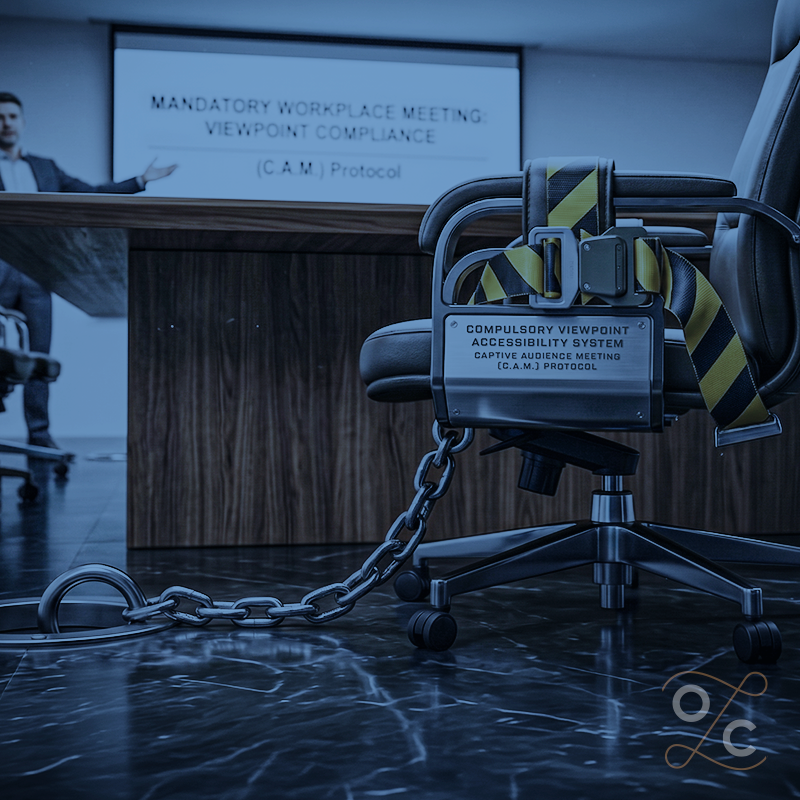
An article published by Connecticut Law Tribune, “Mandatory Meetings: Courts Divided on Murky Area of Employment Law,” examines the growing legal uncertainty surrounding so-called “captive audience” workplace meetings—situations where employees are required to attend meetings in which employers communicate views on political, religious, or labor-related issues.
According to the article, courts are increasingly divided on how to reconcile newer state laws restricting mandatory attendance with longstanding federal labor law principles that historically allowed employers to communicate their views to employees about workplace matters, including unionization. This tension has created a patchwork of legal standards across jurisdictions.
For example, Connecticut enacted legislation prohibiting employers from disciplining employees who refuse to attend meetings primarily intended to communicate the employer’s political or religious views. Similar laws have been adopted in several states, including New York, where legislation restricts employers from requiring employees to attend meetings communicating political or religious opinions—including views concerning labor organizations.
At the federal level, however, the legal landscape is evolving. The National Labor Relations Board has recently scrutinized mandatory “captive audience” meetings under the National Labor Relations Act, signaling a shift toward limiting the circumstances in which employers may compel employees to attend such discussions. In some jurisdictions, mandatory attendance policies may expose companies to statutory claims, while in others the issue remains governed primarily by federal labor law principles.
From a legal and risk-management perspective, the issue presents several areas of exposure. Employers may face disputes over whether attendance was voluntary, litigation arising from disciplinary action against employees who refuse to participate, and challenges asserting that workplace communications crossed into protected political or labor-related activity.
The broader takeaway is that workplace communications—particularly those touching on political, religious, or union-related topics—should be carefully structured and regularly reviewed. Employers benefit from ensuring that policies governing employee meetings are clear, voluntary where appropriate, and aligned with evolving state and federal legal developments.

Outside Legal Counsel LLP advises employers, executives, and boards on employment-law compliance, workplace policies, labor-relations strategy, and risk management arising from evolving federal and state regulatory frameworks. Contact us today.
This is not legal advice and is attorney advertising.
#EmploymentLaw #LaborLaw #WorkplacePolicies #HRCompliance #UnionIssues #CorporateGovernance
Disclaimer: Nothing on this website is or should be construed as legal advice. An attorney-client relationship does not exist with our firm unless a signed retainer agreement is executed, and we do not offer legal advice through this site or any of the content located on it. For legal advice for your particular circumstances, please contact us directly.
